Table Of Content
Indoor construction in a controlled environment means exterior finishes are completed last, instead of first. We can build your new home from the inside out, the opposite of conventional outdoor construction. What this means to you is that the building envelope of your new home can be fabricated to be super energy efficient.
Where Are Millipedes Usually Found?

They can’t close these holes, so moisture is constantly leaving their bodies. Indoors, use a dehumidifier to keep air dry, and keep cardboard boxes and other organic materials away from concrete slabs and floors. Choosing the right lender to finance your new manufactured home or modular home is just as important as the home purchase itself.
#4. Use Natural Pest Control Solutions
They undergo four post-larval instars before reaching maturity. House centipedes have a pair of legs called forcipules right below their mouths, converted to carry out pincer-like actions. They use these pincer-like legs to discharge a venomous sting at their prey or use it for self-defense. The pair of legs at the end of centipedes’ bodies is very long and resembles the antennae in front.
Conditions
All these things can cause huge delays in the building process and create a negative experience for the home buyer. At ModularHomes.com, we want your home buying and building journey to be as stress-free as possible. Building in California is no exception – that’s why choosing modular construction guarantees that your home will be built much faster and for less money. Impresa Modular prides itself in producing the most energy efficient home possible. Currently an Energy Star partner, Impresa Modular offers many features as standard that meets or exceeds current Energy Star, LEED, and Green Building Standards. Impresa Modular allows you, the customer, the choice to enhance any of our modular homes to meet the requirements for the program of your choosing.
Why Do I Keep Finding Millipedes In My House?
Some of the fluid could be toxic in large quantities, but the amount millipedes produce is harmless to people. These arthropods don’t even care for your wood or any house structure. It allows you to create a protective barrier around your backyard or home perimeter to keep the millipedes and other tiny millipede looking bugs away. Your basement and garage can provide the perfect environment for millipedes to thrive. And if your place is accessible nearby, they’ll take refuge in your home and become indoor house millipedes. Unfortunately, millipedes are a pretty common sight in our modern homes.
All house centipedes are venomous, but they typically run away from humans, and they very rarely bite. If you’re already facing a pest infestation with the likes of cockroaches, termites, and spiders in your house, the chance of having house centipedes is higher. Basements or other damp and dark areas in your house that don’t see much activity are a perfect place for house centipedes to thrive. If you’re someone who can’t stand the sight of worms or cockroaches, or if you have arachnophobia, chances are you won’t appreciate having house centipedes around you, either.
Preferred Food Sources
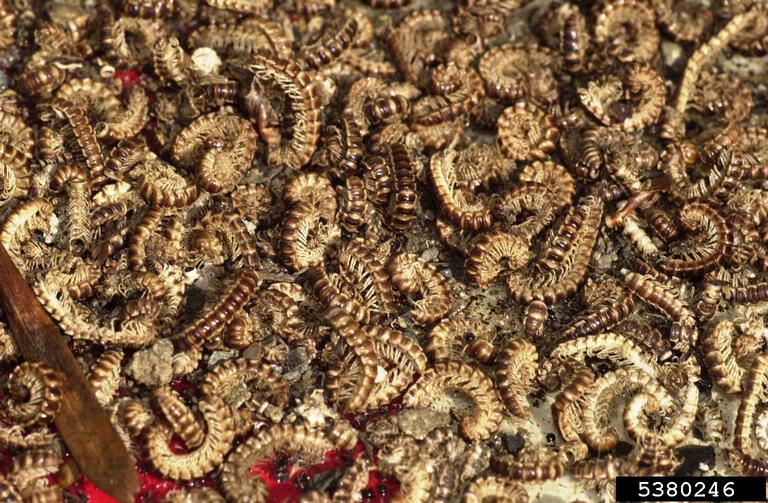
Frequent indoor sightings of these pests usually means that there are large numbers breeding outdoors in the lawn, or beneath mulch, leaf litter or debris close to the foundation. Millipedes do not survive indoors for more than a few days (more likely just a few hours) unless they can find suitable moist conditions. The most effective way to prevent a centipede infestation is to reduce areas of moisture in and around your home. Remove piles of leaves and grass clippings, logs, stones and rocks on your property.

If outdoor infestations are severe, you can apply a band of pesticide around the foundation to discourage these bugs from seeking entry into your home. A granular form of lambda-cyhalothrin or permethrin works well for this. Amanda Rose Newton is a pest specialist and horticulture expert, reviewing pest control and gardening content for The Spruce's Cleaning and Gardening Review Board. Her passion for pest control and sustainable gardening allows her to review plant and pest content for best practices and accuracy. She is a board-certified entomologist and volunteers for USAIDs Farmer to Farmer program. She is a professor of Horticulture, an Education Specialist, and a pest specialist.
What attracts millipedes to the house?
There could be many reasons millipedes are getting into your house, but most of those reasons are because they are seeking shelter from undesirable elements outside. If all the above measures don’t work, or if taking all those previous steps sound like tasks you don’t have the time or energy for, you can call a professional pest agency. While you are looking inside your crawlspace, look out for wet areas or puddles. These can be indicators of an outside leak or pipe leaks that will cause more problems later on, as well as inviting more insects inside. They’re also waterproof, don’t attract insects, and last longer than cardboard boxes. These are all areas where millipedes and other pests could come into your domicile.
Since centipedes are nocturnal, it can be tough to determine whether you have them in your house. One of the first signs of a centipede infestation is seeing them regularly in your home. But this could signify the presence of other arthropods or pests that are prey for the house centipede–a sign of a bigger problem. Centipedes are generally dark brown or yellow and sometimes have darker colors and markings. Adult centipedes have three dark parallel lines running from their head to the rear end of their bodies and a hair-covered pair of antennae on their heads.
If handled roughly, some larger species can inflict a painful bite that can break human skin and cause pain and swelling, similar to a bee sting. The large Scolopendra can inflict a very painful bite and should be handled with great care. Tips to reduce moisture and breeding sites around structures. However, large numbers of them crawling into the house and dying on the carpet/floor can quickly become a seriously annoying nuisance.
Delve into detailed specifications, browse through photo galleries, and take virtual 3D tours of diverse home models. Discover offerings from America’s premier prefabricated home builders and retailers. Connect with experienced manufactured home lenders for guidance. Whether your interest lies in manufactured homes, modular homes, or park models, our extensive collection of home plans caters to a variety of preferences. Impresa Modular is a nationwide modular home provider that helps you build your new custom home and do it at the best value possible.
Extremely wet conditions where soils become water-saturated will also force them to the surface and higher ground where they often end up on concrete slabs, foundations and siding. Millipedes may also migrate in the fall, presumably in search of overwintering sites. All of these activities result in millipedes invading crawl spaces, basements and other areas of buildings. Common points of entry include door thresholds (especially at the base of sliding glass doors, garage doors), expansion joints, and through the voids of concrete block walls (Figure 5).
Extremely rare venomous centipede found in UK toilet - The Independent
Extremely rare venomous centipede found in UK toilet.
Posted: Tue, 23 Jan 2024 08:00:00 GMT [source]
So, regular maintenance and cleaning of your front yard or garden beds are highly recommended. Moisture is the primary reason for millipedes to enter your home. These thin brown worms in our house also can be spotted when the temperature is too cold. You’d either want to get out of your own house or make sure that each of these wiggling insects is driven out of your home.
While some centipede species have compound eyes containing up to 200 optical units, others have a few simple eyes on each side of the head. All you have to do is figure out where they’re living, and dry it up. If the moisture is due to too much mulch, remove some of it; if it’s caused by a leaky pipe or a damaged gutter, fix that situation. They need moisture to survive, so once you remove that, it’s game over. Millipedes need rich, decomposing matter that’s very moist to live their best lives. Millipedes are very misunderstood creatures that are very beneficial in the landscaping.
It would be very unusual to need stronger pest control for these creatures. Mature millipedes often overwinter in the soil or under leaves, and lay eggs in these same materials in the springtime. Because millipedes can live for years, many that you’ll see in the garden have simply been going about their business for quite some time undetected.


No comments:
Post a Comment